
Kentucky Witch Bottles: Archaeology, Belief, and Evidence
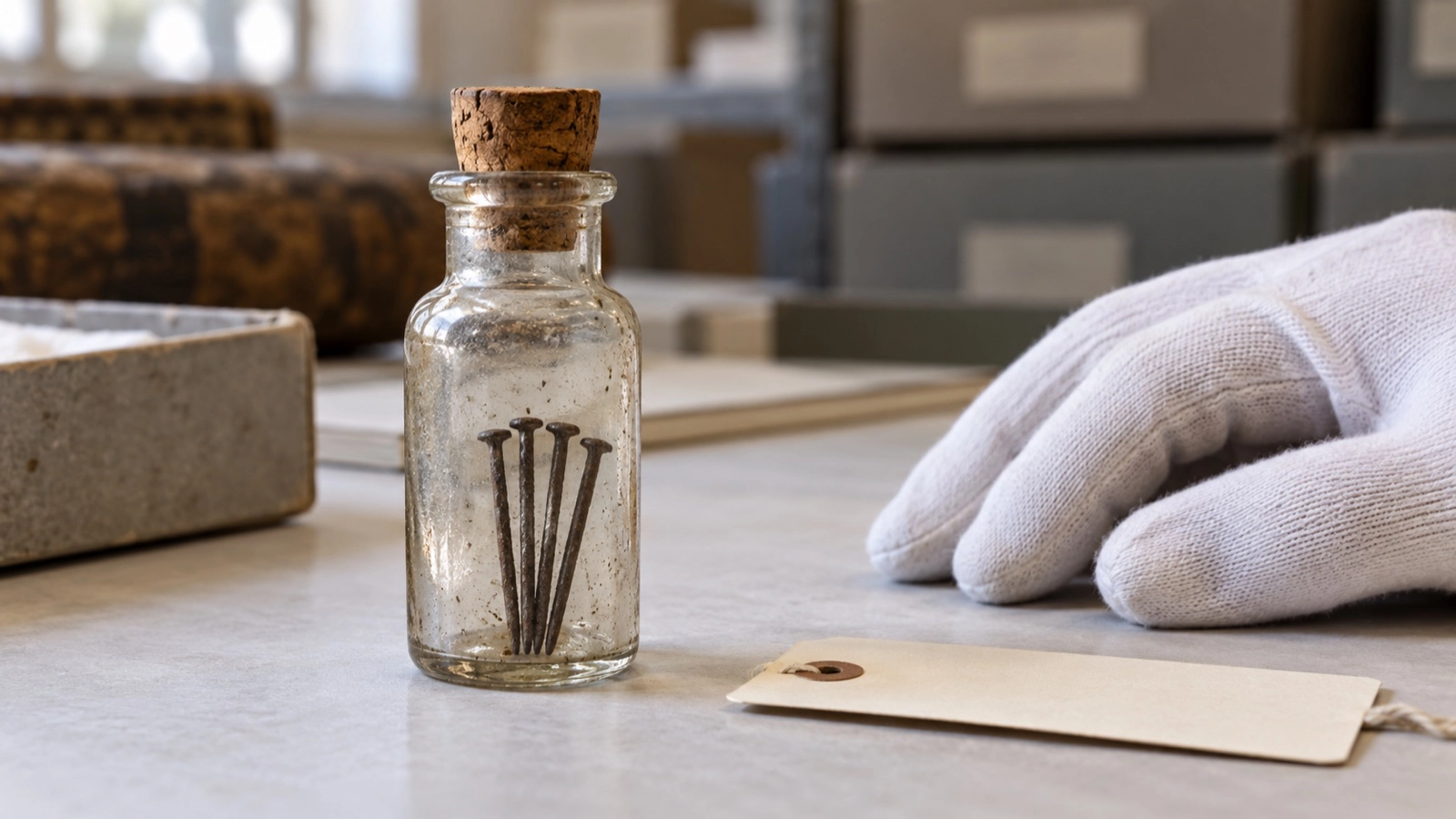
A small medicine vial recovered from an antebellum Fayette County farmstead offers something rare in Kentucky folklore: a physical object with a documented archaeological context. The vial contained four straight pins and was still corked when archaeologists found it. The Kentucky Archaeological Survey says it may have been a “witch bottle,” but that careful word—may—matters.
The find does not prove that a named resident practiced witchcraft, nor does it confirm every ritual described in later accounts. It does show that an object consistent with protective-magic traditions was present at a Kentucky household site. The most interesting story begins where the evidence does.
What archaeologists actually found
The object came from archaeological site 15Fa185, the John Armstrong Farmstead, along the former Maysville-to-Lexington Turnpike in Fayette County. The Scott family occupied the farm beginning in 1820 and built a modest house around 1830. The Cummins family owned it from 1838 to 1846, when Irish immigrant John Armstrong bought the 44-acre property. The Armstrong family remained there until 1880.
Excavations by Cultural Resource Analysts documented the footprints of domestic buildings and outbuildings and recovered thousands of artifacts. Among them was a hand-blown medicine vial, closed with a cork, with four straight pins inside. The state’s public site record describes it as a possible witch bottle or anti-witch charm.
That description is an archaeological interpretation, not a label left by the person who assembled the object. The public record does not identify that person, state which household owned it, or demonstrate why it was deposited. Because several families occupied the farm, attaching the bottle to one resident would go beyond the evidence.
Why the pins and placement matter
In European and Euro-American folk practice, containers holding sharp objects were sometimes concealed in or near buildings as protective deposits. Some traditions treated a bottle as a household amulet; others described it as a countermeasure meant to turn an alleged harmful influence back on its source. The Kentucky Archaeological Survey notes that such bottles could be placed beneath thresholds or hearthstones, elsewhere in a building, outdoors, or in running water, depending on the intended use.
The same source says bodily material such as urine was often thought to be part of the ritual, with pins symbolically redirecting pain. That does not mean the Armstrong vial’s original liquid has been chemically identified. Its documented contents are the bottle, cork, and four pins. The proposed ritual meaning comes from comparison with better-known traditions.
What the bottle can—and cannot—tell us
The vial is evidence that belief, medicine, household protection, and everyday work could overlap. Straight pins were ordinary domestic objects at this farm: archaeologists also found sewing materials suggesting that Mary Armstrong worked as a tailor. An ordinary object could therefore have a second, symbolic use without becoming exotic or separate from daily life.
But context controls the conclusion. A bottle with nails or pins is not automatically a witch bottle. Archaeologists consider the vessel’s age, manufacture, contents, location, relationship to a structure, and whether the deposit appears intentional. Here, the sealed vial and pins make the protective interpretation plausible; the incomplete public record keeps it provisional.
This is also why broad phrases such as “Kentucky witchcraft” can mislead. The find belongs to a specific nineteenth-century household landscape. It should not be used to flatten Indigenous traditions, African American spiritual practice, Appalachian customs, and European-derived charms into one undifferentiated category.
A better way to read the find
The strongest conclusion is modest but meaningful: archaeologists recovered a deliberately corked medicine vial containing four pins from an antebellum Kentucky farmstead, and its form is consistent with documented protective-bottle traditions. Who made it, what they called it, what else it contained, and what they hoped it would do remain unknown.
That boundary does not weaken the story. It restores the object to the world in which it mattered—inside a working farmstead where families managed illness, uncertainty, labor, and belief with the materials at hand. For a related Kentucky example of how archaeologists interpret symbolic objects without collapsing distinct traditions, see Protective Marks and Superstitions in Kentucky Folk Tradition.
Sources and further reading
- Kentucky Archaeological Survey: John Armstrong Farmstead (15Fa185)
- Kentucky Archaeological Survey: The Culture of Enslaved People—a separate Kentucky case showing why artifact context and cultural attribution matter




About the Author: Kantuckee


