
Protective Marks and Superstitions in Kentucky Folk Tradition
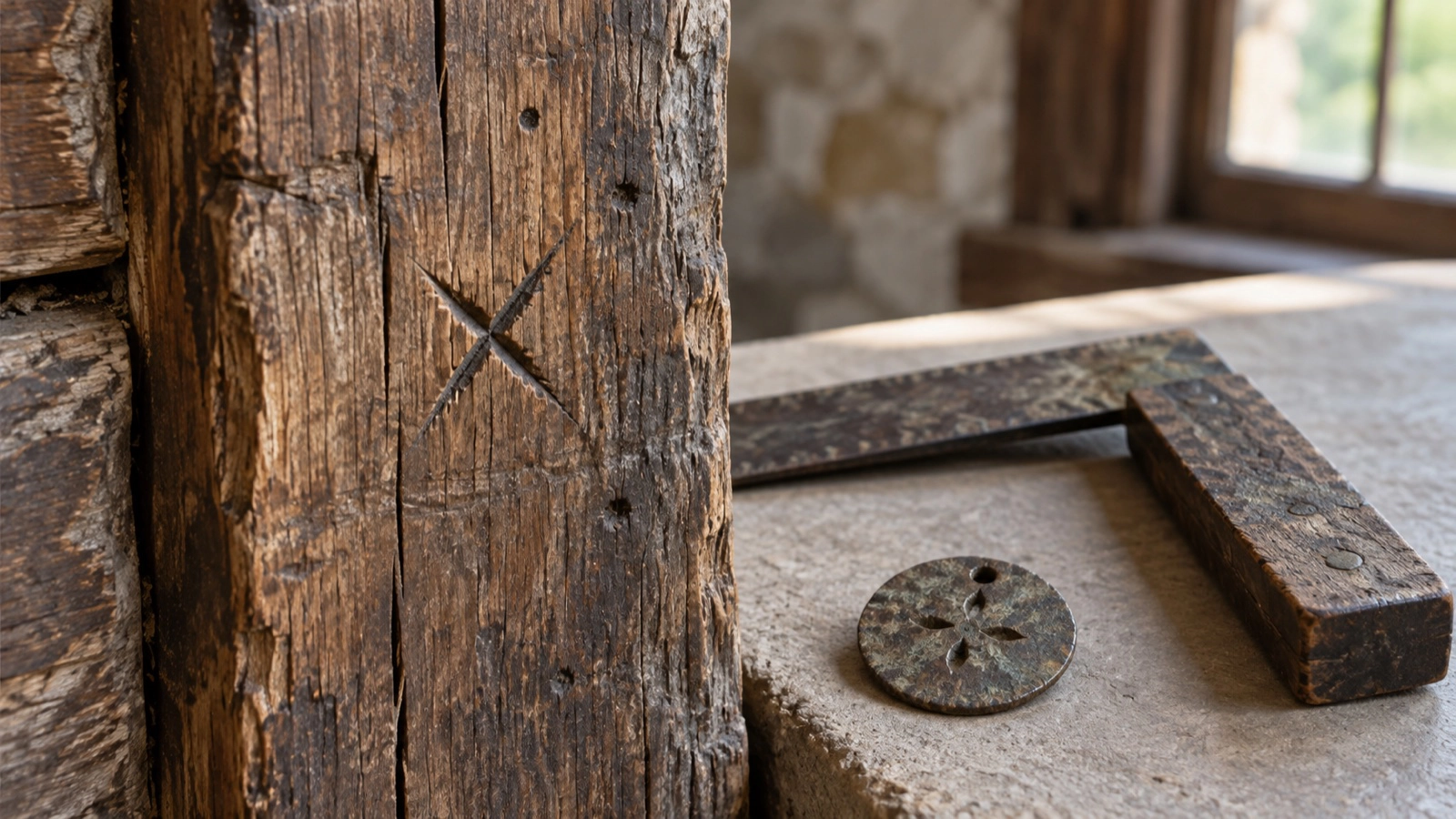
A scratched X, a pierced coin, a bottle hidden near a foundation, and a carved figure on stone may all look mysterious. They do not necessarily mean the same thing. Kentucky’s landscape preserves marks and objects created by Indigenous artists, enslaved people, craftspeople, builders, families, and later visitors. Calling all of them “witch signs” erases the very histories that make them worth studying.
The responsible question is not “Is this a supernatural symbol?” It is “Who made it, when, on what material, and in what setting?” Kentucky archaeology provides several useful examples of how context changes the answer.
One mark can have many explanations
Marks on historic woodwork can be layout lines, carpenter’s marks, ownership marks, repairs, tally systems, children’s drawings, later graffiti, or deliberate ritual protection. Wear, tool shape, repetition, building date, and placement can help distinguish them. A mark near an entry or fireplace may invite a protective interpretation, but location alone does not prove it.
The phrase apotropaic mark means a mark intended to avert harm. It is useful when evidence supports that function, but it should not be applied merely because a design resembles examples found elsewhere. Comparative material from Britain and Europe can help researchers recognize possible forms; it cannot establish the intent of a Kentucky maker without local evidence.
A Kentucky example from an enslaved household landscape
At Riverside, a former plantation in Jefferson County, archaeologists investigated outbuildings where enslaved people lived and worked. A pewter spoon handle recovered from a detached kitchen bore an X. The Kentucky Archaeological Survey says X-marked objects at enslaved sites are thought to represent the Bakongo cosmogram, a spiritual symbol with roots in west-central Africa.
Other finds at Riverside included a pierced George Washington token. Archaeologists have found pierced coins and tokens, blue beads, crystals, caches, and related objects at enslaved sites across the Southeast. These objects can reveal private religious and protective practices that enslavers’ written records ignored or suppressed.
This interpretation is culturally and historically specific. It should not be renamed a European “witch mark,” and it should not be generalized into a claim about every X scratched on an old object. The artifact, building, associated community, and comparable archaeological pattern support the reading together.
A different tradition: the Fayette County bottle
At the antebellum John Armstrong Farmstead in Fayette County, archaeologists recovered a corked, hand-blown medicine vial containing four straight pins. The state describes it as a possible witch bottle or anti-witch charm. Comparable traditions used concealed containers as household protection or as countermeasures against alleged harmful magic.
The bottle is not evidence that every Kentucky farm had such a practice, and its maker is unidentified. It is a documented object whose form makes a protective interpretation plausible. The full context is explored in Kentucky Witch Bottles: Archaeology, Belief, and Evidence.
Do not confuse historic rock art with folk magic
Kentucky also contains fragile Indigenous rock-art sites spanning more than three thousand years. Researchers have documented human and animal figures, footprints, and abstract or geometric designs. These works belong to Indigenous histories and archaeological contexts; they are not a generic inventory of “witch signs.” Mislabeling them encourages false interpretations and can also draw damaging attention to sensitive sites.
Never chalk, wet, rub, trace, clean, or carve a mark to make it easier to photograph. Do not publish coordinates for a vulnerable site. A photograph with scale, the object or building location, and information about the surrounding material is more useful than a dramatic close-up stripped of context.
How to evaluate a claimed protective mark
- Document before interpreting. Record the entire object or building element, the mark’s dimensions, material, height, orientation, and nearby features.
- Establish a date range. Building records, construction phases, tool marks, fasteners, paint layers, and archaeological strata may narrow when it was made.
- Test ordinary explanations. Look for repeated measurements, assembly marks, hardware scars, later vandalism, or functional wear.
- Use culturally relevant comparisons. Match the place, community, time period, and artifact type—not just the shape.
- State the confidence level. “Possible protective mark” is more accurate than a confident label when the maker and purpose are unknown.
Why the distinctions matter
Protective practices can be part of Kentucky folklore without becoming one blended “superstition.” European-derived household charms, African and African American spiritual traditions, Indigenous art and belief, Christian symbols, and practical builders’ marks have different histories. Treating those traditions as interchangeable hides authorship and can repeat old stereotypes.
The evidence is most compelling when the interpretation remains proportional to it. A careful label leaves room for uncertainty while preserving the human question behind the mark: what danger did someone perceive, and what did they believe might keep a household or community safe?
Sources and further reading
- Kentucky Archaeological Survey: The Culture of Enslaved People
- Kentucky Archaeological Survey: John Armstrong Farmstead
- University Press of Kentucky: Rock Art of Kentucky
- Gresham College: Ritual Protection Marks and Witchcraft at Knole, Kent—comparative European context, not proof of a Kentucky mark
About the Author: Kantuckee


