
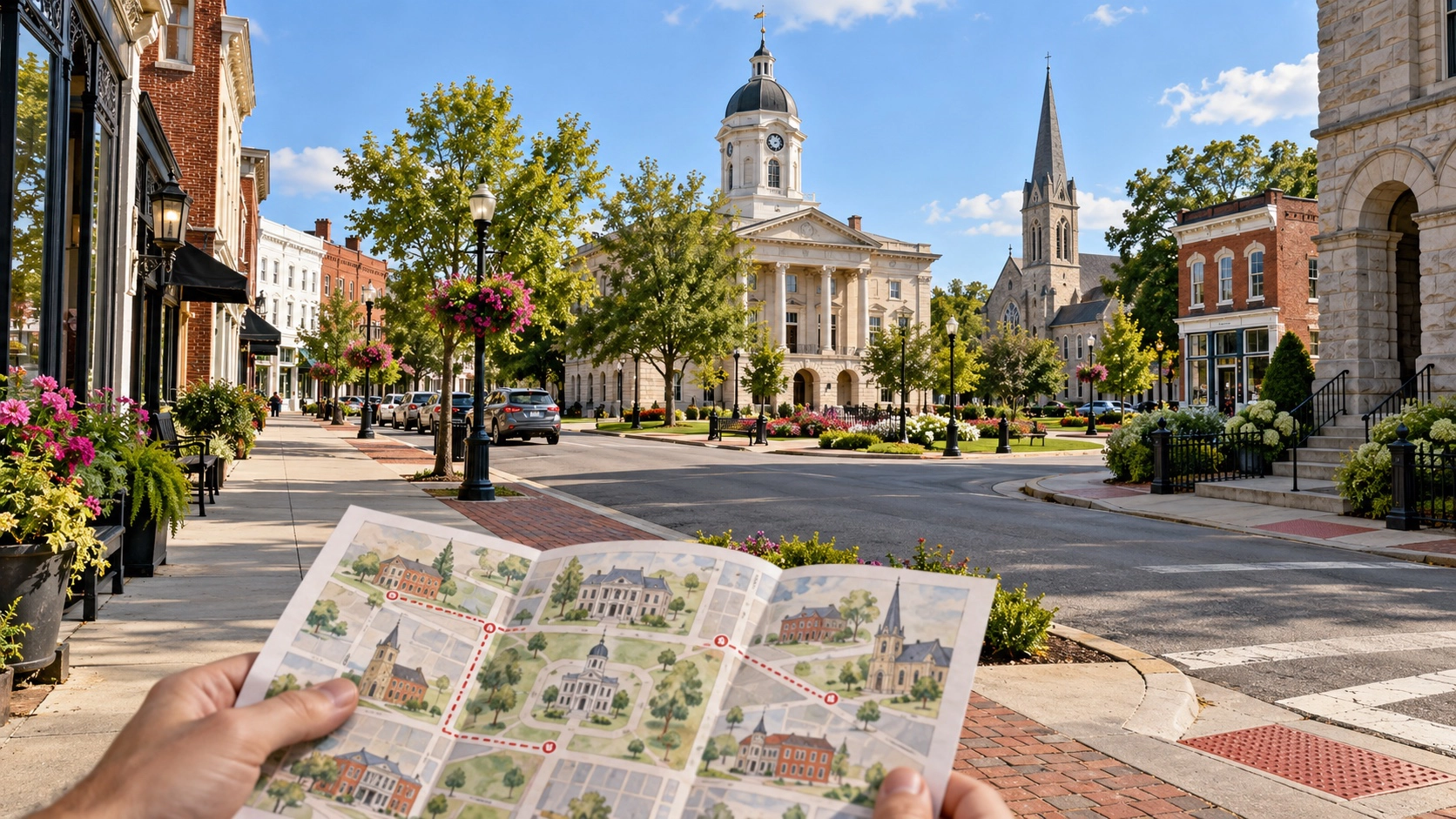
Bardstown’s downtown contains a dense group of historic buildings, but the most useful walk is not a contest over which Kentucky town has “the most.” A short loop can show how courthouse, religious, educational, commercial, and carceral architecture shaped the city while keeping public access and living uses clear.
Start at the 1892 courthouse
The former Nelson County Courthouse at Court Square now houses the visitor center. An earlier courthouse stood on land set aside as Bardstown developed in the eighteenth century. Begin with a current walking map and ask about construction, events, and interior hours.
The courthouse lawn also carries layers of commemoration. Read markers as products of their installation dates as well as evidence about the events they describe. A monument is not a neutral substitute for a full history.
Old Talbott Tavern and the commercial square
The stone-and-timber tavern represents Bardstown’s role on early travel routes, but it is also an operating business. Exterior viewing from public space does not promise access to guest rooms or private event areas. Separate documented building history from later celebrity and outlaw legends.
As you walk, compare older materials and proportions with later storefront alterations. Active shops and restaurants show preservation as continued use, not a frozen streetscape.
Old Nelson County Jail
The former jail is now a lodging business. Its limestone construction and long institutional use are part of the public streetscape, but the rooms, courtyard, and grounds are not automatically open to non-guests. Treat stories of incarceration, execution, and alleged hauntings with restraint.
The nearby cemetery should be entered only through a lawful public route. Do not touch, rub, clean, or climb markers.
Basilica of St. Joseph Proto-Cathedral
The church reflects Bardstown’s importance in early Catholic history west of the Appalachians. It remains an active place of worship. Check visitor hours, avoid services and ceremonies unless attending respectfully, silence devices, follow photography rules, and dress for the setting.
Its formal design can be compared with nearby domestic and civic buildings, but architecture should not obscure the institution’s broader histories, including education, migration, enslavement, and church governance.
Spalding Hall
A Kentucky Historical Society marker records that the 1826 building served St. Joseph College, a seminary, an orphanage, a preparatory school, and a Civil War hospital. It now houses the Oscar Getz Museum of Whiskey History and other uses. Confirm museum hours separately before expecting interior access.
What the walk can and cannot show
Visit Bardstown describes nearly 200 historic downtown buildings, while a recent tourism history article cites 279 structures across 26 National Register district blocks. Those figures use different scopes. Neither means every property is old, publicly accessible, or preserved without alteration.
Architecture can reveal materials, scale, use, and changing taste. It cannot by itself explain who built a structure, whose labor maintained it, who was excluded, or how a site was interpreted later. Use museum, archival, church, and descendant sources to fill those gaps.
Walking safely and accessibly
- Stay on public sidewalks and crossings; do not enter porches, gardens, or alleys without permission.
- Ask the visitor center about grades, curb cuts, construction, seating, and accessible entrances.
- Do not block doors or photograph through private windows.
- Use a shorter loop in heat, ice, heavy rain, or crowded events.


