
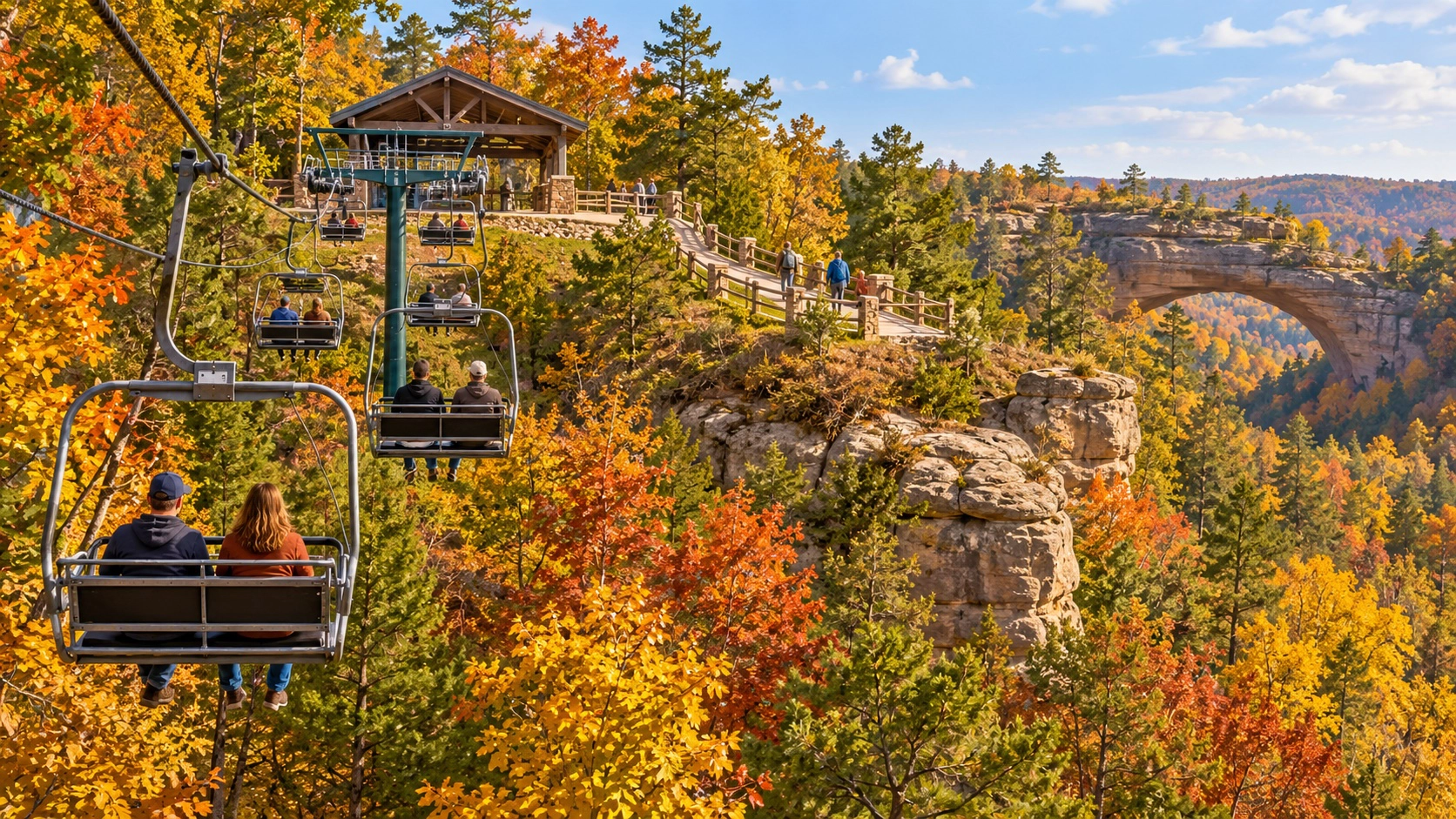
The Natural Bridge Skylift offers a seasonal shortcut toward one of Kentucky’s best-known sandstone arches. It is useful for visitors who want to reduce—but not eliminate—the walking required to reach Natural Bridge. The chairlift ends about 600 feet from the arch, so riders still need to manage an outdoor path and changing terrain.
Operations, fares, and weather closures can change. Check the official Natural Bridge State Resort Park page and call the skylift at 606-663-2922 before making a special trip.
Skylift quick facts
- Operating season: The park lists daily operation from the first weekend in April through the last weekend in October.
- Starting point: About one-half mile from the park entrance.
- Upper station: Approximately 600 feet from Natural Bridge.
- Tickets: Contact the operator for current prices and hours.
- Weather: Wind, storms, maintenance, and other conditions can interrupt service.
What the ride does—and does not—provide
The skylift carries passengers up the slope in an open chair. It is not an enclosed gondola, and boarding requires moving onto and off a chair at the stations. The short walk from the upper station to the bridge may still include uneven natural surfaces. Anyone with limited mobility, balance concerns, a fear of heights, or a child who may have difficulty sitting securely should ask the operator about boarding and ride requirements before buying a ticket.
A round-trip ticket can avoid the steep climb from the valley, but it does not turn the visit into a step-free experience. Confirm whether the route from parking to the lower station and from the upper station to the viewpoint fits your needs. The park’s accessibility information and staff are better guides than photographs or old visitor reports.
Hiking alternatives
Visitors can also hike to Natural Bridge. The Original Trail is a roughly half-mile linear route rated moderate by the park, with about 500 feet of elevation change. Its short mileage can be misleading: the sustained climb and stone surfaces make it more demanding than a level half-mile walk.
Other routes in the park vary considerably:
- Balanced Rock Trail: A strenuous route with more than 600 steps and about 0.75 mile of linear distance. The park currently notes that it is closed partway, so verify its status before choosing it.
- Laurel Ridge Trail: Begins as an easier ridge walk but later includes stairs. It is about 0.75 mile one way.
- Combination trip: Some visitors ride one direction and hike the other. Confirm that one-way tickets are available and choose the downhill route carefully; steep descents can be hard on knees and slick after rain.
Use the park’s current trail descriptions rather than assuming every line on an older map is open. Allow more time than the mileage suggests, especially with children, crowds, wet rock, or fall leaves covering steps.
Pets and protected areas
Most trails within the park’s nature preserve do not permit pets. Nearby Red River Gorge trails may have different rules, but those rules do not override restrictions inside the preserve. Service-animal access is governed separately. Check the exact trail and current park guidance before arriving with an animal.
Safety and seasonal planning
Wear shoes with dependable traction and carry water. Sandstone, roots, steps, and leaves can become slippery. Stay behind barriers and away from cliff edges; a viewpoint does not become safe because it is crowded or frequently photographed.
Fall color attracts heavy traffic, but there is no guaranteed peak date. Weekday mornings may reduce congestion. In hot weather, the shaded forest can still be humid, while exposed ridge areas may feel much warmer. Thunderstorms and high winds can affect both hiking and lift operations.
A practical visit plan
- Check the park page, weather, trail notices, and skylift operation the morning of the visit.
- Decide whether everyone in the group can board an open chair and complete the remaining walk.
- Arrive with time for parking and ticket lines, particularly on autumn weekends.
- Carry water and keep children close near overlooks and cliff edges.
- Have a backup plan, such as a lower-elevation park walk, if the lift closes or conditions deteriorate.
Official sources
- Natural Bridge State Resort Park: activities, trails, and skylift information
- Natural Bridge State Resort Park overview


